
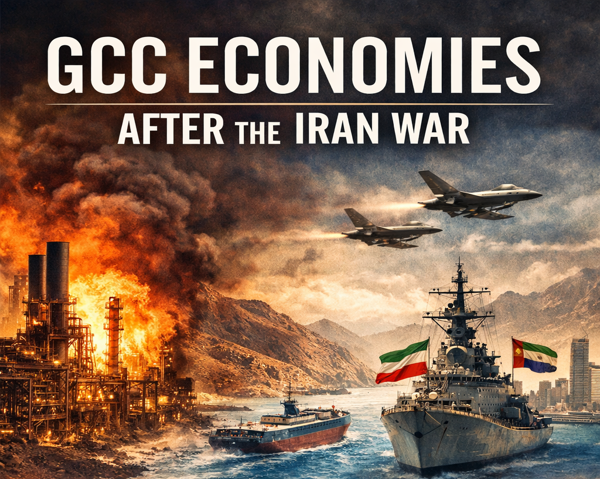
GCC Economies After the Iran War
The GCC states strongly opposed war with Iran, yet they were still caught off guard when hostilities began. Gulf leaders understand better than most the scale of destruction such a conflict could bring. Their concern is rooted in experience. They have long feared a scenario in which the United States enters a war, fails to bring it to a decisive end, and then leaves the region to absorb the consequences alone. For the GCC, a prolonged conflict would not only threaten security. It would devastate economies, disrupt development plans, and take decades to repair.
Gulf governments also view this conflict through a hard strategic lens. Many see it as a war of choice, shaped more by Israeli strategic calculations than by Gulf interests. For that reason, they have little desire to be drawn into it.
Before the war, the regional balance, while far from stable, served Gulf interests in important ways. Iran remained constrained by sanctions and international isolation. Although Tehran continued to project power through proxies in Yemen, Iraq, and Lebanon, the GCC states were still able to manage the threat. With support from Western allies, they contained Iran’s reach while continuing to build their economies, attract investment, and pursue ambitious development agendas.
The outbreak of war has shattered that balance and opened a dangerous new chapter. Its consequences remain uncertain, but even the most optimistic outcome would leave the region fundamentally altered. Economic transformation would no longer dominate national priorities in the same way. Defense, deterrence, and strategic survival would move to the center of Gulf policymaking.
This war has also reinforced a harsh lesson for GCC leaders. They sit in one of the world’s most exposed and contested geographies, shaped by centuries of rivalry, empire, and upheaval. They must now find a way to secure prosperity while living beside a large, historically ambitious, and often aggressive neighbor.
Paradoxically, Iran may emerge from this war with greater leverage, even if it suffers military damage. Tehran has now seen how much pressure it can exert on the region and the global economy. The mere threat of disrupting the Strait of Hormuz is enough to send markets into panic. Its other major pressure point is the Houthis in Yemen. If Iran were able to use them to seriously threaten or close the Bab al Mandab, it would gain enormous leverage over the GCC, the United States, and the wider international system. Such a development would be devastating for global trade and would amount to a nightmare scenario for Gulf economies.
Yet amid these risks, Saudi Arabia may be the one GCC country best positioned to convert crisis into long term strategic advantage. In nearly every scenario, the Kingdom has an opportunity to strengthen its role as the political and economic leader of the Arab Gulf. Its scale, financial capacity, energy weight, and diplomatic reach already set it apart. A prolonged regional crisis would likely deepen this position rather than weaken it.
Saudi Arabia also holds a geographic advantage that few others in the Gulf can match. Its access to both the Arabian Gulf and the Red Sea gives it strategic depth at a time when maritime chokepoints have become central to regional risk. If the Strait of Hormuz becomes unstable, Saudi Arabia still retains an outlet to the Red Sea through its western ports and related infrastructure. This gives the Kingdom the potential to emerge as the primary logistics and trade hub for the GCC in a more dangerous regional environment.
In such a scenario, Saudi Arabia would not only protect its own economic resilience. It could also become the main logistics lifeline for its Gulf neighbors. Over time, this could shift regional trade and supply chain gravity toward the Kingdom and away from existing hubs such as Jebel Ali and Dubai. War has a way of redrawing commercial maps. Saudi Arabia is one of the few states in the region with the geography and scale to benefit from that shift.
Several scenarios could now emerge, each carrying major consequences for the GCC.
Scenario 1. A U.S. withdrawal without a durable settlement
If the United States halts the war and withdraws from the Gulf without securing a long term framework to contain Iran, this would be the worst outcome for the GCC. It would leave Iran politically emboldened and strategically stronger. Tehran would likely expand its influence across the region and intensify pressure on its Arab neighbors, who would face a more aggressive Iran with fewer guarantees of external protection.
Even in this scenario, Saudi Arabia may emerge as the central Arab power responsible for holding the Gulf together. Its leadership role would become more important as smaller GCC states look for political coordination, economic stability, and strategic cover.
Scenario 2. A deal that limits Iran’s nuclear program but leaves it dominant in Hormuz
If Washington ends the war through an agreement that curbs Iran’s nuclear ambitions but leaves Tehran with de facto leverage over the Strait of Hormuz, the GCC would face a different but equally dangerous challenge. Gulf economies would remain exposed to Iranian pressure at the most critical maritime chokepoint in the world. Energy exports, shipping security, and investor confidence would all become vulnerable to Iranian leverage.
This scenario would increase the strategic value of Saudi Arabia’s Red Sea access. It would push greater focus toward western corridors, pipelines, ports, and inland logistics networks connected to the Red Sea. In practical terms, Saudi Arabia would become even more important to the future movement of trade and energy from the Gulf to global markets.
Scenario 3. Defeat of Iran and the rise of a more moderate government
If Iran is militarily defeated and the current regime is replaced by a more moderate leadership, the GCC would gain important strategic breathing space. Such an outcome could reduce immediate tensions and create a more favorable regional environment for perhaps a decade or two. Still, Gulf leaders would remain cautious. Iranian strategic ambition is older than the present regime. Any future government in Tehran, even a less ideological one, may still seek dominance in the Gulf through political, economic, or military means.
In this scenario, Saudi Arabia would likely gain through diplomacy and reconstruction politics. It would be well placed to shape a new regional order, lead reconciliation efforts, attract capital, and reinforce its standing as the main Arab center of stability and economic gravity.
Scenario 4. Direct GCC entry into the war
If GCC states are forced into direct military participation, the conflict would likely expand and drag on for years. The costs would be severe. Economies would suffer, infrastructure would become vulnerable, investor confidence would collapse, and even territorial security could be tested. This is the true worst case scenario for the Gulf. It is the outcome regional leaders fear most, for reasons so obvious they should not need explaining.
Even here, Saudi Arabia’s scale and geography give it relative advantages over others. It has more room to absorb shocks, redirect logistics, and reorganize trade flows. This does not mean it would escape damage. It would not. But it would still be better positioned than many others to recover faster and lead the postwar regional economic realignment.
The Iran war is not a distant geopolitical contest for the GCC. It is a direct threat to economic stability, regional order, and long term national development. The Gulf states built their recent success during a period in which Iran was dangerous but contained. That era may now be over.
What comes next will shape the region for years. Whether through American withdrawal, diplomatic compromise, regime change in Tehran, or wider regional escalation, every path carries serious risk. Yet within this uncertainty, Saudi Arabia stands out as the Gulf state most likely to turn crisis into strategic advantage. Its political weight, economic ambition, and Red Sea access give it tools that others do not have. If the regional map is redrawn by war, Saudi Arabia is in the strongest position to shape what comes next.
Hi, this is a comment.
To get started with moderating, editing, and deleting comments, please visit the Comments screen in the dashboard.
Commenter avatars come from Gravatar.